Victor Papanek’s Social Design Legacy: A Book Review

Karen Fraser, MA History of Design and Material Culture, reviews a new book that explores pioneering ideas and practices in global social design.

Victor Papanek [1923-1998] was an Austrian-American designer, author and activist who was concerned with design and its social, environmental and ecological consequences.  His pioneering attempts to disseminate the word of social design meant he led a peripatetic lifestyle, and as a result he left traces in institutions around the world. Victor Papanek: The Politics of Design is a 400-page catalogue published to accompany the exhibition of the same name held at the Vitra Design Museum from 29 September 2018 to 10 March 2019. The catalogue could be said to animate the archives; it seeks connections amongst the photographs, drawings, documents, and objects that Papanek created or in some way left his mark upon over a career beginning in the 1940s and continuing through the 1990s. Through essays, interviews and a series of provocations offered by contemporary designers, the catalogue aims to answer the question: what is Victor Papanek’s legacy for the twenty-first century?

Fig. 1: Daniel Streat. Cover of Victor Papanek: The Politics of Design. 2018. First published by Vitra Design Museum and Victor J. Papanek Foundation, University of Applied Arts Vienna.

The front and back covers offer an ambiguous visual introduction. White shapes appear to refer to things in the real world, but it is not immediately clear what those things are. Through five themed sections, it is revealed that some refer to objects designed by his students, some to things he has collected, and others to diagrammatic visualisations made in his notebooks. Further still, one points to a contemporary designed object, the Nike Pro Hijab, which was launched in 2017 and carries functional and symbolic significance for its intended wearers, female Muslim athletes. This inclusion addresses a gap in Papanek’s legacy: for all his merits, he paid little attention to the intersection of design and gender. As curator Amelie Klein notes in the catalogue’s opening essay, there are five contemporary design projects included in the exhibition that expose assumptions about gender, but they stand apart from the works by Papanek and his contemporaries. However, in exposing the Nike Pro Hijab’s potential for becoming a lucrative commodity, the curators link it to an aspect of Papanek’s record that is surer footed, that of his critique of consumerism. Contributor Dr Garnet Hertz identifies that Papanek’s work to ‘shift design from a type of marketing into a type of public service’ is deeply relevant to the late capitalist moment we are in now. As such, the catalogue contextualizes Papanek’s life and career in a way that recognizes its strengths and reckons with its failures.

Fig. 2: Nike Pro Hijab. Advertisement. 2017. Nike News. 30 May 2019. https://news.nike.com/news/nike-pro-hijab. JPEG File.

One aspect of Papanek’s work that offers much to reckon with today is his role with the International Council of Societies of Industrial Design (ICSID), established in 1957 by European and American designers who aimed to professionalise design through the development of international standards and design education across political and economic boundaries. Among its contributions, The University of Brighton Design Archives provided an image of the Ahmedabad Declaration on Industrial Design for Development, presented at the 1979 United Nations Industrial Development Organization (UNIDO)/ICSID Design for Development Congress. Professor Alison J. Clarke, who is the Papanek Foundation’s current director and who previously taught at the University of Brighton for several years, acknowledges that Papanek’s contribution to the congress reflected the way socially responsible design was thought of at the time, where the Global South provided ‘fresh fodder for design’.

Fig. 3: Ahmedabad Declaration on Industrial Design for Development. January 1979. ICD-6-4-4-3. ICSID Archive, University of Brighton Design Archives.

Thoughtful treatment of controversial topics such as this one characterises the catalogue and, as Vitra Design Museum director Dr Mateo Kries writes in his foreword, ensures that Papanek’s significance within the history of design is developed in a manner that is detailed and academically sound. Alongside many contributors who reside globally, two University of Brighton researchers lent their expertise to the exhibition and catalogue: Dr Tania Messell, who drew heavily on the ICSID Archive for her PhD in the School of Humanities, co-supervised by Dr Lesley Whitworth, Design Archives Deputy Curator, and Professor Jeremy Aynsley; and Dr Leah Armstrong, current head of archive at the Papanek Foundation, whose collaborative doctoral project was based in the Design Archives and was supervised by its former director, Professor Catherine Moriarty. These connections reveal some of the local, national and international networks of researchers whose insights made Victor Papanek: The Politics of Design possible.

This catalogue stands solidly on its own and will be of interest to those familiar and unfamiliar with Papanek’s legacy. Students and practitioners of design and its social, political and global history will find many points of connection to make between the complex issues that concerned Papanek and his collaborators and those that confront us today.


Outlandish millinery fit for a king in Brighton’s pleasure palace

Wendy Fraser, volunteer at Brighton Museum and Art Gallery and MA History of Design and Material Culture student, shares her insider insights on an innovative new display at the Royal Pavilion.

Stephen Jones Hats, the exhibition at the Royal Pavilion that opened on 7 February 2019 and runs until 9 June 2019, celebrates over 150 hat creations designed by the milliner Stephen Jones OBE. After studying millinery at Central St Martins (and being taught dress history by University of Brighton’s Professor Lou Taylor), Jones opened his first shop in Covent Garden in 1980 and just two years later one of his hats was bought by the V&A for their collection. He has designed hats for celebrities and royalty and has collaborated with fashion houses and couturiers including Dior, Thom Browne and Giles Deacon. The hats in the exhibition have been garnered from private lenders, designers and Jones’s own archive.

Figure 1 3D printed bust of Stephen Jones wearing a specially made top hat in the Octagon Hall of the Pavilion. Photograph by Tessa Hallman, 2019. Image courtesy of Brighton Museum.

Co-curated by Stephen Jones and Martin Pel, the curator of Fashion and Textiles at Brighton Museum and Art Gallery, the exhibition has been designed as a tour through the Royal Pavilion with the hats, grouped by theme, ‘peopling’ the rooms. The visitor is greeted in the Octagon Hall by two gilded busts of George IV and Stephen Jones commissioned especially for the exhibition and wearing oversized hats: a velvet bicorne hat from Galliano’s Spring/Summer 2009 show for the Prince Regent and a crimson velvet top hat upon Jones’s head (Figure 1). Jones has made headwear for George IV before: his statue in Trafalgar Square was adorned with a gold hat in the shape of one of the Pavilion’s domes and topped with a rounded minaret (the hat is displayed on the bed in the Yellow Bow Room) while the horse he sat astride sported a smaller version. Both hats were designed for  the millinery showcase Hatwalk when some of London’s most famous statues were behatted as part of the celebrations for the London Olympics in 2012.

The Pavilion provides a fitting background for Jones’s hats which are as dramatic and fantastical as the opulent interiors of the royal palace.  Jones has links to Brighton; his Spring/Summer 2012 collection Chinoiserie-on-Sea was inspired by the Pavilion and he has carried out research for his work in the costume store at Brighton Museum which is where the idea for this exhibition was first proposed. It is this collection of Brighton-themed hats, connecting to the architecture and seaside location of the city, which visitors first encounter in the entrance hall.

Figure 2 Stephen Jones’s hats on display in the Great Kitchen, Brighton Pavilion. Photograph by Tessa Hallman, 2019. Image courtesy of Brighton Museum.

In the banqueting room the table is set for 26 hats worn by some of Jones’s most famous clients including Lady Gaga, Mick Jagger, Kylie Minogue and Boy George. The two wider, most prestigious chairs at the star-studded dinner party are reserved for a top hat from the 1920s which belonged to Jones’s grandfather and a hat that he has replicated for George IV from a portrait painted in 1782, demonstrating that hats have always been ‘an important social and historical item of dress.’ [1] The great kitchen has a whimsical display of hats themed around food, the underwater world and birds (Figure 2). A seagull hat designed for the New York brand, Thom Browne, is displayed high up in the kitchen as though ready to sweep down and steal chips – a witty nod to Brighton’s beach menaces.

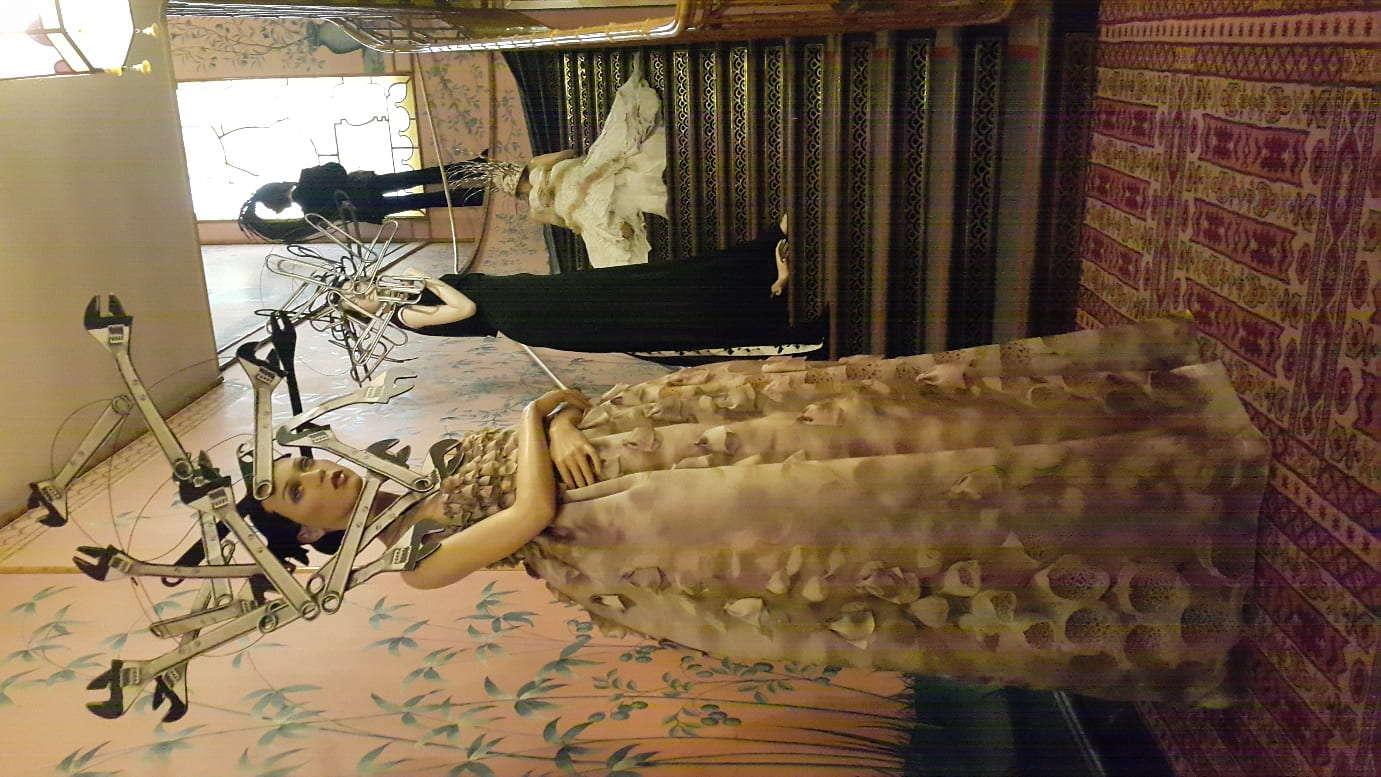
I have been volunteering at the museum with Martin Pel since Autumn 2017 and have been involved in the behind-the-scenes preparation for the show. It’s been a fascinating experience, and has included visiting the studio of Zenzie Tinker Textile Conservation (where individual mounts have been made for each hat to enable their display on metal stands) and helping to measuring the heights for the hat stands in their different display configurations. I assisted on a shoot where each hat was individually photographed for the guide panels, I met the artist who has gilded the 3D printed busts in her studio, and when it came to the installation of the exhibition, I helped to put hats into their locations. There are entire outfits by Giles Deacon, Thom Browne, John Galliano for Dior and Maria Grazia Chiuri for Dior on display, with the hats that Jones made to accessorise them.  During the installation a team from Dior came to the Pavilion to dress the Dior mannequins but I was able to assist by dressing some of the mannequins with the Giles Deacon outfits and moving them into position with Martin (Figure 3). This was thrilling but also quite nerve-wracking!

Figure 3 Giles Deacon outfits with Stephen Jones runway headpieces. Photograph by Tessa Hallman, 2019. Image courtesy of Brighton Museum.

During his speech at the private view, Jones spoke about the exhibition and observed that ‘hats tell a story’. The hats worn by the glitterati of our times exhibited in the Royal Pavilion help to remind the visitor that the Pavilion was a pleasure palace – a venue for lively parties attended by glamorous aristocratic guests. The interaction between the hats and the architecture and furnishings of the Pavilion allows the hats to transcend their function as headwear. Depending on where they are positioned, they appear as sculptural objects of art in their own right, at times complimenting the colours and style of the sumptuous interiors, at others arresting the eye with their incongruous shapes and materials. Clair Hughes describes the wild nature of millinery in a way that surely the hedonistic George IV would approve of: ‘a hat has the license to be what it wants’, she writes, ‘it can take off in any direction in almost any material and much can happen as it leaps into the void. Hats, like the best pleasures, are risky.’ [2]

[1] Oriole Cullen, Hats: An Anthology by Stephen Jones, (London: V&A Publishing, 2009) 11.

[2] Clair Hughes, Hats (London: Bloomsbury, 2017) 14.

Political history and popular culture: Researching Baltic design

Triin Jerlei, a postdoctoral researcher at Vilnius University, Lithuania, and graduate of University of Brighton, shares her new research project in the history of design. 

I received my doctorate from Brighton University in 2016, following my MA in History and Design and Culture, for research on Soviet Estonian industrial designers from the 1960s until the 1980s. Until recently most of my research focused on Estonian local design under the Soviet power as a case study in the development of a ‘Western Soviet’ design system. However, in my research I noticed that too often I was comparing Soviet Estonian regional design systems and processes with those taking place in capitalist countries or in Moscow as the ‘centre’, instead of other so-called ‘peripheral’ Soviet states. Therefore it became my dream to conduct a transnational comparative study between the design systems of two former Soviet states.

In general there is not a lot of research on Soviet design systems, especially in the late Socialist period. While Stalinism and the Thaw are easier to define both in their political tendencies and their chronological span, Late Socialism, often also called Stagnation, is a complex era characterized by different processes of globalization and regionalization throughout the vast Soviet Union. As remaining isolated was not sustainable, foreign trade and tourists played an increasing role in the economy, facilitating  the spread of global trends especially in the Western Soviet regions. A complex combination of various political, economical and cultural processes shaped the development of regional design cultures, which is the topic of my research.

The delivery of a transnational project on the history of several former Soviet republics was complicated by political factors, as archives are not fully accessible in many former Asian Soviet republics. Additionally it was important that I could read the local language relatively quickly, which is easiest with a language that uses Latin script. For these reasons I chose Lithuania as my second country of comparison and I decided to focus on the construction known as ‘Baltic design’. While Estonia and Lithuania were similarly situated on the Western border of the Soviet Union and had close historical and cultural connections, there are still significant differences between the two countries, which this research will clarify to provide a better understanding of the interrelations between different ‘peripheries’.

I was incredibly lucky to receive funding from the Lithuanian Council of Sciences. Thanks for this, I have been able to take up a two-year postdoctoral position at the Kaunas faculty of Vilnius University, supervised by Professor Virginija Jurėnienė. The decision to move to Lithuania instead of working in Estonia was deliberate, not only to learn about the history of Lithuanian design, but also to understand its present state and its situation in the wider culture. Additionally it has been exciting to get to know a new local research environment and to discover more about the general cultural scene.

So far, I have discovered that in spite of close connections between the Baltic states in the Soviet Union, the design systems differ in some key aspects. These variations are largely caused by differences in local design traditions. A good illustration is souvenir production. Both countries used wood as a locally available material, but where Estonian souvenirs were often useful objects (or replicas of objects that had once served a function), in Lithuania one finds numerous small wooden figurines, often based on folklore. This difference between minimalism in Estonia and rich ornament in Lithuania can also be seen in other fields of design. In terms of the organization of design systems, the design institutions of the two states were connected and cooperated closely, but had different structures.

I hope that this research will contribute to global design history by diversifying the understanding of different local stories of design. The ‘mundane’ fields of design and the systems behind everyday material culture are often at risk of being forgotten. One of the most exciting aspects of working with the materials from the 1970s and 1980s has been the role that these objects still play in living memories and environments, thanks to their ordinariness and ubiquity.

P.S. As a part of my Fellowship I am organizing a symposium in Kaunas, on the subject of design and creative economies. Details can be found here: http://www.knf.vu.lt/en/making-and-shaping-things-in-creative-economies