Oscar Sampson standing next to dissertation poster project on display

Engineering dissertation poster projects: Oscar Sampson, Automotive Engineering MEng

“This project strengthened my capabilities in sustainability analysis, systems modelling, and technical reporting, all essential in modern automotive, energy, and engineering roles. It’s given me confidence working with real-world data, new software, and engineering trade-offs.”

At the University of Brighton, final-year projects give engineering students the chance to tackle real-world challenges and make an impact. These projects combine technical knowledge, research skills, and creativity, often addressing some of the most pressing issues in energy, transport, and sustainability.

In this blog, we speak with Oscar Sampson, an Automotive Engineering MEng student about their project, which focused on developing a standardised Life-Cycle Assessment (LCA) methodology to evaluate the true environmental impact of energy technologies.

Continue reading “Engineering dissertation poster projects: Oscar Sampson, Automotive Engineering MEng”
James Allan with dissertation poster on display

Engineering dissertation poster projects: James Allan, Automotive Engineering MEng

“The most surreal and rewarding moment was when the work led to a published paper in the International Journal of Hydrogen Energy. Achieving that as an undergraduate was something I never imagined.”

At the University of Brighton, final-year projects are more than just an academic requirement, they’re an opportunity for students to showcase their creativity, technical skills, and problem-solving abilities. These projects often tackle real-world challenges, from sustainable energy solutions to advanced manufacturing techniques, giving students a taste of what it’s like to work as professional engineers.

In this blog post, we catch up with Automotive Engineering MEng student, James Allan to learn more about their dissertation poster project and how it has helped to shape his future career.

Continue reading “Engineering dissertation poster projects: James Allan, Automotive Engineering MEng”
Brighton Space Agency team photo with procket

University of Brighton engineering students fly high in national rocketry competition

If you’re considering studying engineering and want hands-on experience that launches your career (literally) then the University of Brighton might just be your launchpad (pun totally intended).

In their first-ever entry into the prestigious UKSEDS National Rocketry Championship, a team of 14 engineering students rocketed to success, finishing 7th out of more than 50 teams from across the UK.

Their high-performance carbon fibre rocket, designed and built entirely by students, soared to an altitude of 1,819 feet and returned safely—an impressive feat for a debut team.

Alexander Gooch, one of the team members, said:

“For our first-year competing, finishing 7th out of over 50 teams is an incredible achievement. We’ve learned so much from building and testing our designs, and it’s been amazing to see all our hard work come to life on launch day. We’re really proud of how far we’ve come and grateful for the support we’ve had.”

Continue reading “University of Brighton engineering students fly high in national rocketry competition”

Life Cycle Analysis of Electric Vehicle Batteries – final year MEng project work

In this second post, we learn from Erin, Connor, Sadiq, Ade and Don, the STEP Lab master’s team on Life Cycle Analysis theme, as they graduate with MEng degrees in Aeronautical and Mechanical engineering between them. 

What is LOBSTER

The aim of our project was to estimate the CO2 impact of second life, and end of life (EOL) processes of electric vehicle (EV) batteries, considering the batteries destinations i.e. recycling, energy storage etc., state of health, and battery types/compositions. To do this, we used data from literature and Ecochain Mobius. Results were summarized as a new piece of software written by the STEP Lab team, offering Logical Outputs Based on Statistics and Testing for End-of-life Re-purposing (L.O.B.S.T.E.R).

Continue reading “Life Cycle Analysis of Electric Vehicle Batteries – final year MEng project work”
Three students standing outside lab

Testing Energy Recovery Machines – final year projects

STEP Lab offers engineering experience to problem-solve energy challenges in a multi-disciplinary, real-world, project-based, research and development environment, via a Tutor-Student partnership. In this three-post series, the recent student teams from the Lab share their journey of professional engineering experience. 

Continue reading “Testing Energy Recovery Machines – final year projects”
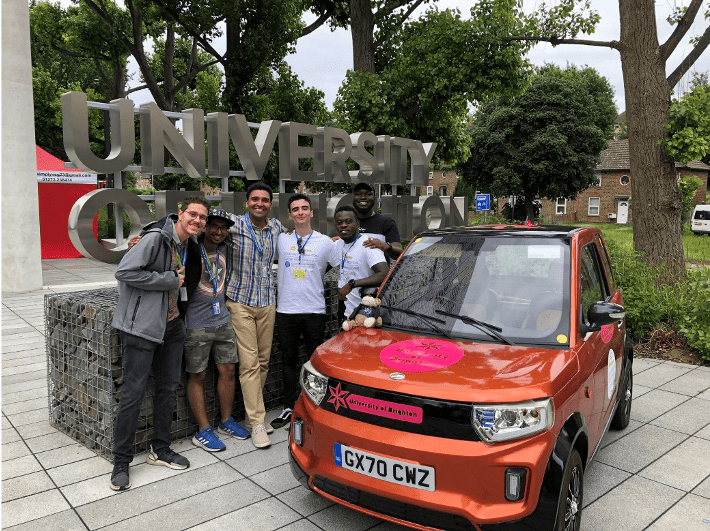
Standing beside electric vehicle by University of Brighton sign

Journey from foundation engineering student to Lead Electric Vehicle Engineer

My name is Emmanuel Sakyi, my journey at the University of Brighton started in 2016 on the Aeronautical Engineering (Foundation Year), now Aerospace Engineering with Integrated Foundation Year. I gained a place for a year in industry as Mechanical Engineering placement student with Network Rail after my second year of studies. After the completion of my project I switched from Aerospace to Mechanical Engineering MEng and carried on through till my final/ master’s year of study. I returned from my year out to most of my year group graduating and the migration of lectures from in-person to remote, due to the pandemic.

Continue reading “Journey from foundation engineering student to Lead Electric Vehicle Engineer”
European Space Agency logo

European Space Agency collaborative projects

Deploy! Project

The DEPLOY! Project is a collaboration between the universities of Pisa, Parma, and Brighton, as well as the European Space Agency (ESA) sponsored PETRI student project, with additional funding received from the UK Space Agency.

The project focuses on the dynamic deployment of a novel satellite radiator panel thermal interface using a flexible Pulsating Heat Pipe. This research aligns with the ongoing work on Pulsating Heat Pipes at the universities of Brighton and Pisa. The project team, consisting of five Masters’ students and one PhD student, has been mentored by experts from the partner universities, who have provided access to their expertise and key experimental equipment. The DEPLOY! team, led by Erin Saltmarsh from the University of Brighton, has been spearheading the manufacturing and mechanical design aspects of the project.

The flight campaign for the DEPLOY! Project is scheduled to start on November 20th in Bordeaux, France. To learn more about this exciting project, visit their website.

Gell-P (Gravitational Effects of Lower Limb Perfusion)

Gell-P is a collaborative project between the School of Health Sciences and the School of Architecture, Technology and Engineering. The project aims to investigate the effects of gravity on foot perfusion to support a wider demographic of astronauts and mitigate injuries. By evaluating foot vascular flow under varying gravity conditions, the project seeks to understand lower limb injury healing for long-term astronaut missions.

The collaboration involves a team of podiatrists from the School of Health Sciences, led by project PI Rachel Forss, along with support from a team of engineers from the School of Architecture, Technology, and Engineering.

The experiment, designed and built at the AEB, will be tested during the 83rd European Space Agency parabolic flight campaign starting on November 20th. Read this post to learn more about this fascinating project.

European Low Gravity Research Association (ELGRA)

Dr Nicolas Miche has been selected as a mentor for the first European Low Gravity Research Association mentoring scheme. ELGRA is a nonprofit international society that promotes European research in microgravity, simulated microgravity, and hypergravity conditions. It serves as a platform for scientists interested in life and physical sciences in space.

The goals of ELGRA include representing and strengthening the scientific community of altered gravity research and involving young people in research through educational programmes.

ELGRA achieves these goals by organising scientific symposia and courses, cooperating with institutions and agencies to organise scientific events, spreading information about opportunities and new platforms, and supporting students and young scientists through grants and educational programmes from ESA.

Male student sitting down with a dog and smiling at the camera

Mindful thought processes, science and a world of possibilities

In this blog, automotive engineering student and course representative James Allan, reflects on a recent module, and how it has further enhanced his knowledge and skills as a ‘graduate of the future’.

I have been actively engaged in the Energy Systems modules for 12 weeks and I can honestly say it has been a very interesting subject. With regard to the modern world, there are a vast array of everyday items that rely on productive and efficient energy systems. This module has primarily focused on the transportation sector, whilst also covering fluid dynamics, thermal storage systems, heat exchangers and refrigeration systems.

Continue reading “Mindful thought processes, science and a world of possibilities”
Close of female student in engineering lab wearing a white lab coat and safety glasses looking at the camera

Focusing on solutions and sustainability in engineering

Mechanical engineering student Isabel Paglinawan tells us about the Energy Systems modules and reflects on how it has enhanced her knowledge and skills as a ‘graduate of the future’.

Critical Thinker
The ‘Energy Systems’ module, gives us the opportunity to undertake learning in a much more practical approach. Our lecturers have first-hand experience working in relevant industries that made it really engaging. They gave us problems similar to ones they have faced in the industry and walked us through their way of finding a solution. As students, we had to think critically about each possible solution and its possible effects.

Aside from many real-life relevant problems, we engaged with many visuals during lectures which kept our learning experience engaging and easier to visibly understand the function of systems such as Turbofan or Gasoline engines.

Continue reading “Focusing on solutions and sustainability in engineering”
Erin Saltmarsh headshot

Engineering project exhibition 2023: Erin Saltmarsh, Aeronautical Engineering MEng

I have found projects and opportunities, such as the university robot wars, STEP lab projects, or the ESA PETRI programme, especially enjoyable. They have allowed me to engage more deeply with my subject, network with other like-minded people, and engineers, and gain a variety of skills applicable to industry.

Please tell us about your project

I am working in the STEP (Sustainable Technology and Engineering Project) lab to look for improvements to a parametric optimization process, for coil wound heat exchangers, that uses Aspen EDR, developed by a previous STEP lab student. In addition, I am using a combination of simulation, and experimental methods to compare the performance of different types of heat exchangers, such as fan cooled, plate, and coil wound heat exchangers.

Why did you choose to study engineering at Brighton?

I have always been interested in engineering and aircraft. When looking for a degree at college, this subject felt like the best fit and appeared to have everything that I wanted from a degree. The apparent niche of aeronautical engineering, compared to mechanical engineering, for example, also seemed enticing.

Continue reading “Engineering project exhibition 2023: Erin Saltmarsh, Aeronautical Engineering MEng”