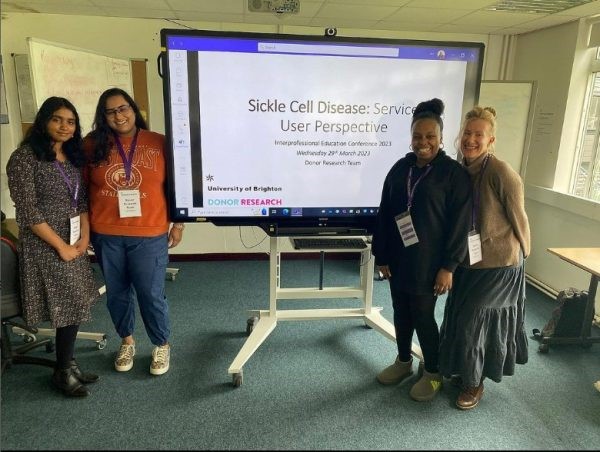
Group of students standing in front of a presentation about Sickle Cell Disease

Donor Research – co-creating student-led donation awareness education

The University of Brighton Donor Research Team is comprised of student champions and academics from the School of Sport and Health Sciences and the School of Applied Sciences, and wider collaborators from other universities, organisations, charities and the NHS.

It has been a busy year for the team with another round of funding secured from NHS Blood and Transplant (NHSBT) to continue our work in educating the student population on organ and blood donation to address the health inequalities in ethnic communities. Read about the new funding secured by the University of Brighton’s Donor Research team.

To further develop our work the team invited Stephanie George from Red Cells R us to share her experience of having Sickle Cell Anaemia at the Year 3 Healthcare Student Interprofessional Conference in April. Swetha Kalaimani, a University of Brighton Donor Research Student Champion, interviewed Stephanie. Read about Stephanie and her experiences.

Rebecca Craig and Charlotte Humphris, academics in the School of Sport and Health Sciences, have also been working with Stephanie to transform the BSc nursing curriculum to be inclusive of Sickle Cell Anaemia and the service users experience. Learn more about this important work.

Learn more about the Donor Research Team’s work and how you can collaborate as a student, colleague or researcher:
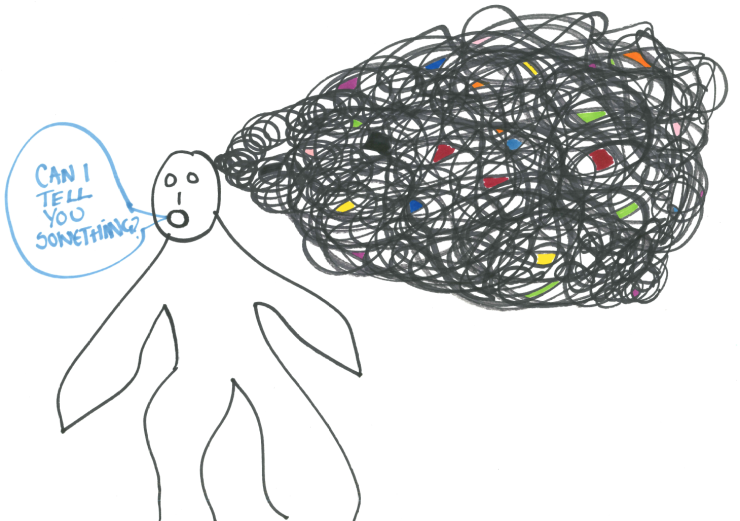
Illustration of man with speech bubble saying 'can I tell you something'

Brighton research reveals hidden sexual abuse of men and barriers to seeking support

University of Brighton researchers have investigated what prevents men reporting incidents of unwanted sexual contact and seeking support in new report.

Exploring this overlooked area of sexual abuse, the MUSE (Men’s Unwanted Sexual Experiences) project uncovered not just the extent of the problem but the reluctance of many victims to report incidents through formal routes – such as the police or a GP – as well as the challenges of seeking informal support from family and friends. Research revealed that a key barrier was the perception held by many that unwanted sexual experiences happen to and impact women, and not men.

Dr Carl Bonner-Thompson, senior lecturer at the University of Brighton’s School of Applied Sciences, is one of the researchers behind the project in collaboration with the Male Survivors Partnership and Mankind UK. Alongside University of Brighton colleagues Dr Kirsty McGregor and Dr Jason Preston, Dr Bonner-Thompson interviewed a number of men in both the south-east and north-east of England as part of the project.

Continue reading “Brighton research reveals hidden sexual abuse of men and barriers to seeking support”
Back of a person crouching down in front of a rock

Brighton researchers to explore better sourcing of vital rare earth elements needed in battle to decarbonise

University of Brighton researchers have received a £799,950 grant to explore more efficient and less damaging ways to source vital rare earth elements.

Researchers from the School of Applied Sciences and the Centre for Earth Observation Science at the University of Brighton have been awarded a £799,950 grant by the Natural Environment Research Council (NERC) to investigate the rock weathering processes in generating deposits of Rare Earth Elements (REEs). Information gleaned from the SCREED project should help to predict resource potential and minimise the environmental impact of extraction.

REEs are part of a group of elements that are crucial components in high power magnets used in renewable power generation and low carbon transport. In particular, neodymium and dysprosium are essential for renewable energy devices such as wind turbines and the development of electric motors. They are, however, in limited supply worldwide, and University of Brighton researchers will explore ways to access supplies in a more sustainable manner by examining the presence of REEs in rocks that have already been partly broken down by natural weathering.

Continue reading “Brighton researchers to explore better sourcing of vital rare earth elements needed in battle to decarbonise”
People taking part in water sampling training on the quay at Chichester Harbour

Research into marine littering from abandoned fibreglass boats

Steady progress is being made on a collaborative community project steered by the University of Brighton. The research – titled Protecting inland coastal waters through innovative citizen science: participatory action-research on end-of-life fibreglass boats – is evidencing end of life and abandoned boats in and around the Chichester Harbour environs.  Led by aquatic ecotoxicologist Dr Corina Ciocan and community water resources practitioner Dr Mary Gearey the aim of the research is to document marine littering from fibreglass boats in poor repair.

Continue reading “Research into marine littering from abandoned fibreglass boats”
Group of scientific researchers in genomics lab

New research centre puts Brighton at cutting edge of the fight against disease

A new UK hub for the development of new and innovative ways to prevent, diagnose and treat disease has opened its doors at the University of Brighton.

The Centre for Precision Health and Translational Medicine brings together experts from a range of fields including biomedicine, engineering, mathematics, computer science and social science to develop new approaches to healthcare. Using the latest technology and techniques such as genome editing and stem cell modification, the centre aims to advance the delivery of personalised, proactive and predictive healthcare, tailored to the needs of individual patients.  

Continue reading New research centre puts Brighton at cutting edge of the fight against disease
Simonne Weeks headshot

Funding boost for Brighton project to encourage more Black and Asian people to become blood, organ and stem cell donors

University of Brighton’s Donor Research team have received a share of £685,000 funding as part of the Government’s commitment to continue to tackle health inequalities and promote organ, blood, and stem cell donation among Black and Asian communities.

Donor Research is an award-winning network of University of Brighton students and academics from diverse backgrounds, supported by healthcare professionals and funded by NHS Blood and Transport (NHSBT). They work collaboratively to advance, support, and shape their community’s awareness of blood and organ donation for a fairer and more equal society.

Continue reading Funding boost for Brighton project to encourage more Black and Asian people to become blood, organ and stem cell donors

Welcoming our first cohort of Global Fellows

The Global Fellowship Scheme provides prestigious awards to enable world-leading researchers and scholars from around the globe to spend between one and three months at the University of Brighton. During this time, they will be able to engage in productive research and build lasting collaborations.

Global Fellows will work in partnerships with University of Brighton colleagues on a joint grant application, produce a co-authored output or co-produced artefact, and share research skills and experience with researchers within our Centres of Research and Knowledge Exchange Excellence and postgraduate students.

We are looking forward to welcoming Professor Alexies Dagnino, University of Valparaiso, Chile in June, who will be collaborating with Dr Melanie Flint.

Continue reading “Welcoming our first cohort of Global Fellows”
A hedgehog in the grass next to some apples

Garden scraps: British wildlife clash over leftover food

Badgers, hedgehogs, foxes and cats are becoming embroiled in fights and stand-offs over food left in British gardens, a study has revealed.

Wildlife conservation experts at the University of Brighton and Nottingham Trent University analysed hundreds of videos supplied by members of the public to investigate interactions within and between different species.

The researchers found that while food left by people in urban gardens – leftovers or commercially bought for this purpose – can provide benefits for wild animals, it can also bring competitors and predators into close proximity.

Continue reading “Garden scraps: British wildlife clash over leftover food”

Meet Professor James Ebdon

I am an Environmental Microbiologist interested in the role of water in the spread and control of water-related diseases. I’m particularly interested in how we can protect human health and aquatic environments.

What drew you to teaching your subject?

I first became interested in water pollution during my undergraduate degree at the University of Brighton, nearly 30 years ago. I was fortunate to be taught by an inspirational lecturer (Prof Huw Taylor) who got us investigating the impact of agriculture on local river water quality. This involved fieldwork at a nearby agricultural college and laboratory testing back on campus. From this moment I never looked back, and to this day I thoroughly enjoy the combination of fieldwork and lab-work. Only now I get to lead fieldwork activities and lecture about the joys of conducting environmental research in a range of challenging settings. 

How do you combine teaching with your professional life/work in the field?

Throughout my teaching career I have been heavily involved with international research projects, conducting fieldwork in Malawi, India, Nepal, Brazil, Vietnam, and Hawaii (funded by UNICEF, Bill & Melinda Gates Foundation, British Council). This has allowed me to bring in contemporary, real-world case material into my teaching on modules such as Global Environmental Challenges, Water, Sanitation and Health and to develop dissertations with my students focussed on addressing pressing environmental challenges. This way students get to engage with and benefit from cutting-edge applied research, long before it has even been reported in leading international scientific journals.   

Continue reading “Meet Professor James Ebdon”
Micrscope image of phages attacking bacteria

MPs back inquiry into powerful new weapon against antibiotic resistance

A University of Brighton researcher has gained Parliamentary support to investigate an ancient foe of bacteria as a weapon against antibiotic resistance.

Antibiotic resistance is a global threat of huge proportions. A 2019 study published in the Lancet estimated that drug resistant infections contribute to 4.95 million deaths per year on average (12,000 of those in the UK) – with the global figure expected to rise to 10 million by 2050. Continue reading “MPs back inquiry into powerful new weapon against antibiotic resistance”