Although curators and artists are often seen to be working in slightly different disciplines, the two can often overlap when a well-established artist is tasked with guest curating a show. A particularly successful example of this overlapping came in early 2021 when Paul Graham, the renowned British photographer, curated an exhibition of photographs for the International Centre of Photography in New York. The show, titled “But Still, It Turns”, included the work of 7 photographers who engage with photography “to portray life as they discover it in the world at large, without staging or manipulation; and by so doing, to find and express themselves.(1)”
It is clear that Graham shares the same concerns as many of the photographers he included in the show, his 40 years of involvement in producing the same socially concerned, documentary style images in his own practice no doubt gave him a unique viewpoint when curating the show, but one that perhaps put him at risk of curating a show of photographs that were rather like his own. I admit that I have only been able to see the pictures included in the exhibition online and in book form but from what I have seen, Graham has navigated this potential problem well, drawing together a collection of works that are as rich in variety as they are in clarity and coherence with his overall aims for the exhibition.
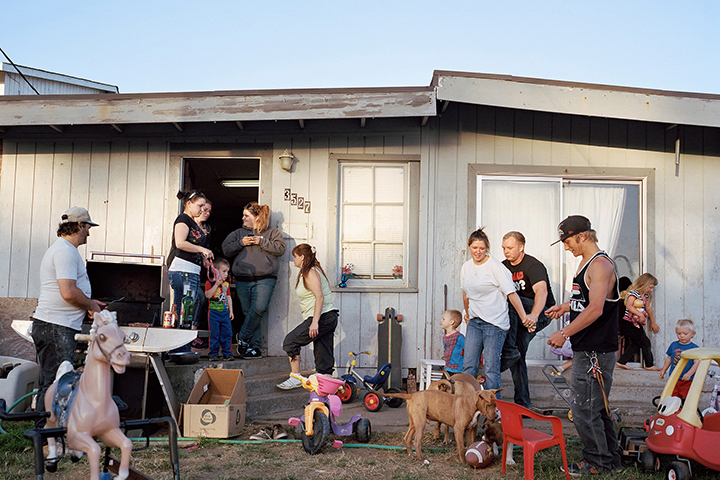
A personal favourite of the photographs included is by Curran Hatleburg, a photographer I had not previously heard of (although including work by established artists such as Vanessa Winship, Graham’s aim to introduce a few new names to the scene of contemporary documentary photographers is clear). The photograph is titled Lost Coast (36), 2014. It is a wonderful tableau, the type that is busy, packed with things just about to happen (steps just about to be taken, words just about to be said, gestures just about to be made and even burgers just about to be BBQed) but still spacious enough to have some clarity and pictorial coherence. Of all the documentary photographs in the exhibition, this feels the most successful at displaying the power a photograph has to distil a moment of action, movement and otherwise chaos into an image that can accommodate multiple viewings, each revealing another detail or occurrence within the lively tableau.
But Still, It Turns is a fine example of artistic practice and curatorial practice crossing over and resisting definition. Graham’s show appears to re-energise the somewhat unfashionable straight documentary photographs he cares about so dearly. With But Still, It Turns, Paul Graham has demonstrated clearly that documentary photography still has a pulse in a time where most photographs on the gallery wall are staged not seen.
Graham, P. (2020). But Still, It TurnsRecent Photography from the World. Available: https://www.icp.org/exhibitions/but-still-it-turns-recent-photography-from-the-world. Last accessed 15th Feb 2022.