How to add humanity

Its a long time since I have added to this blog, and as I had originally only started it as a tool to research my MA critical essay I hadn’t planned on carry on with it. However after some kind comments and my enjoyment of doing the research and the impact it has on my art practise I think I will continue now my MA has finished.

As an aside, I do feel that its important to analyse and explore the effects of this transistion to digital forms of communicationa and look at how we use it and how that then effects are relationships. Does digital communication change our relationships or is it us, that can mold how we use the digital messaging platforms to suit our human needs to communicate on an emotional level?

https://youtu.be/yCrQyLmsKI0


Work No.88

student questions and curators answers to what is conceptual art and what does this peice by Martin Creed say about human interaction with the world around us.


I have added this video as I found it had some interesting comments from the students not just about their understanding of what art is but because it made them question the importance of physical interaction and its connections to our emotions. A point raised by the curator within the video peice. She expressed how this paper ball can represent our emotions unlike now, when we often release our emotional energy online.

This scrunched paper can potentially show anger, frustration, sadness as well as representing our need to be resiliant and to keep trying. This art peice like an emoji adds emotional impact and shares with the viewer what the maker might have been feeling.

Our need to prove our humanity in the form of an emotional reaction brings me to this peice I have been working on at the moment. I have been exploring accidental and evidence of human touch, like lipstick on a glass, finger prints on surfaces and tea stains on tables.

proof of humanity 1

Proof of Humanity, Jenny Nelson “Completely Automated Public Turing test to tell Computers and Humans Apart.” Users often encounter CAPTCHA and reCAPTCHA …

In an age where we are increasingly unsure if what we are looking at actually exsists and how we may need to find ways to prove that we have existed at all.


emoji grammar

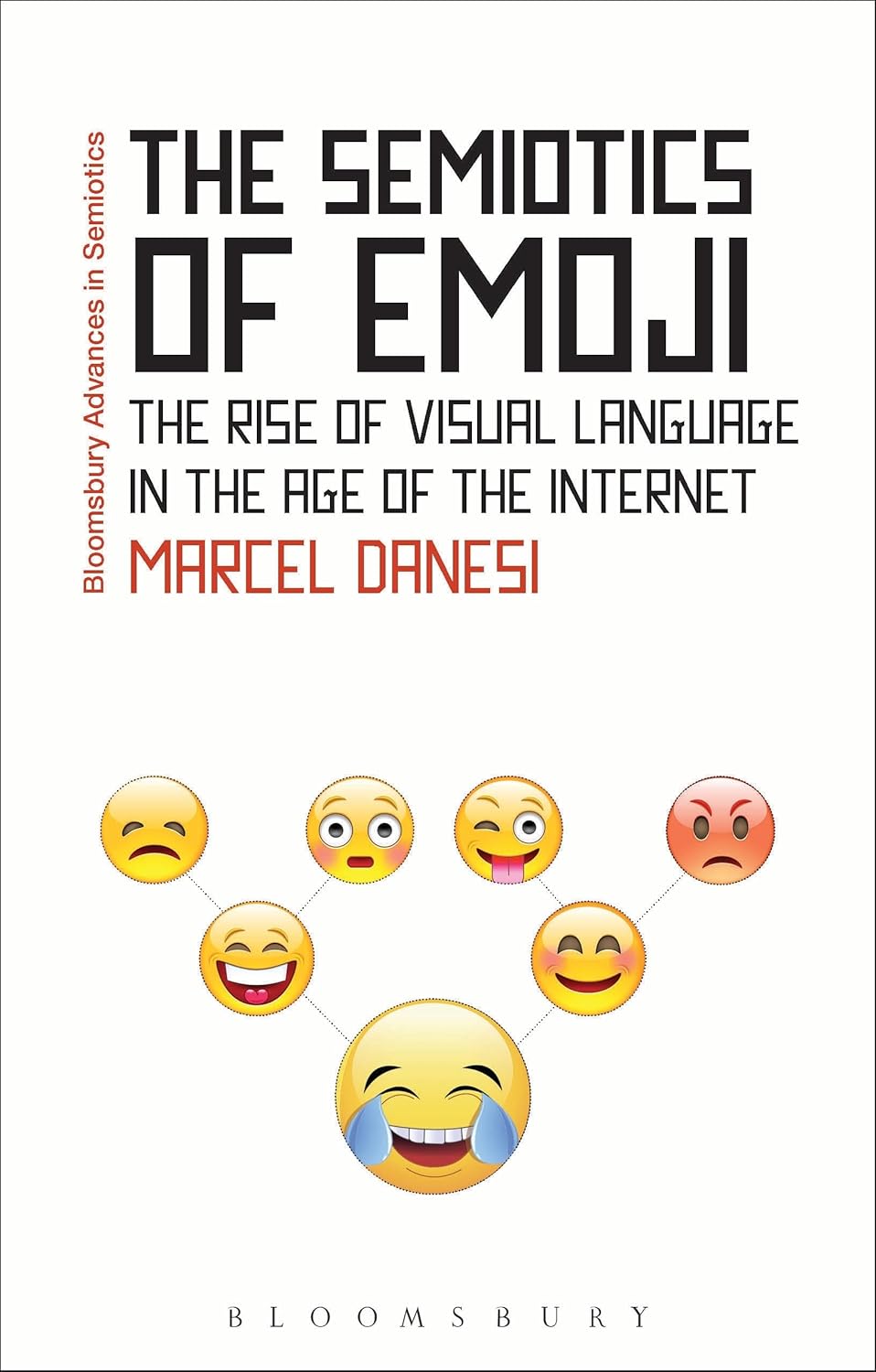
So now I have decided that emoji are the way forward for my critical essay – I need to start picking apart the different elements in the text ‘The semiotics of emoji’. Looking at who the book references and use them to further my own research.

One of the aims is to connect art making to emoji whereever possible for my own work and for the essay.

The chapter emoji grammar mentions an artist Bing Xu  – he constructed a written peice entirely made from emoji. On this page I will take a closer look at his work to find parallels within my own work and to see what connections there maybe to how I answer my critical essay question.

This is the artist’s website.https://www.xubing.com/en/work/details/188?classID=10&type=class

Although this peice is not about emoji, I have put it in as it shares themes in some of the work I had been making. exploring ideas of messages that are taken for granted but have a function. Communicating a caring act  – which ties in with how we care for family through the written and symbolic forms found on digital apps, double ticks, heart emoji, checking in messages ect.


title – ‘The genetics of reading image’

‘Shows that visual and phonic writing are merging more and more.’ Marcel Danesi, the semiotics of Emoji

Chinese Artist Xu Bing's Book Without Borders

links to work I made about Wordle last year. – This could be a useful idea for presenting my critical essay.


emoji writing from ‘point to point’ by Xu Bing


Andy Crush: Xu Bing's Book from the Ground: From Point-to-Point | Book art,  Books, Binghttps://artreview.com/ara-springsummer-2014-book-review-xu-bing-book-from-the-ground/

illustrative signs and emoticons, all taken from real symbols in use around the world. The artist has collated these over a period of seven years and used them to devise a universal ideographic language, in theory understandable by anyone engaged with modern life.

On one level Xu achieves his goal: it doesn’t take too much effort for the reader – ‘interpreter’ might be more appropriate – to decipher the central character’s day. Mr Black decides what shoes to wear (Lacoste, Adidas, Nike logos) and what to have for lunch (McDonald’s arches, illustration of a steaming steak/bowl of noodles/ sushi). He becomes increasingly stressed (series of anxious-face emoticons, each shedding an increasing number of drops of sweat) preparing for a work presentation. There’s humour, too, some of it slightly odd and scatological, as when Mr Black is straining on the toilet (coiled turd with a red line through it, more sweat-shedding emoticon faces). But perhaps this merely reflects the universality of toilet-related symbols. The accompanying explanatory book, The Book About Xu Bing’s Book from the Ground, includes documentation of the wider project when it has been presented in the context of an exhibition, and includes its development as a software program that translates Chinese and English text into pictograms and symbols. Essays and an interview with the artist put the novel in context, both in terms of Xu’s previous work and in terms of historical and more recently devised pictographic languages – not forgetting that the Chinese also retains pictographic roots. –

This section from Art Review explains this peice – it would be interesting to see if I can find the software that changes written english into emoji.

These pages are also interesting in relation to a form of literacy known as ‘Talk for writing’ that was divised to help children to write imaginatively and to understand how a narrative is formed within a text. I have used this method when teaching English in primary schools and through child generated symbols the children match a word, action and the symbols they suggest are put together to learn the key text.

https://www.talk4writing.com/resources/planning/

https://www.youtube.com/embed/en73Pi1V_1c

Pie Corbett who invented talk for writing in schools to help with literacy.


the semiotics of emoji and Goffman’s frame theory

I am going to be looking at these two books, one that talks of how social media has changed the world we live in  and looking at the theories of Gregory Bates and Erving Goffman we coined the phrase ‘framing theory’. Framing theory is about how there are sets of boundaries, rules and expectations around social interactions. These theories on expected and excepted forms of the frames within which we communicate are relevent for both physical in-person interaction and media communications.

The first book is called How the world changed  – Social Media.

Chapter 7 online and offline relationships, p100

‘Authenticity and mediation – looks at why do digital technologies make us fell we are losing something of ourselves?’

‘this is not the first time in history that we have feared this loss of humanity in the face of new technology. Socrates warned of the evils of writing and how this new advancement would be a threat to oral traditions’

This research also delves into how social media, including messaging services like WhatsApp, are used differently depending on country and culture.

chapter 7(*3) human anxiety, new technology in Marvin C. 1988n ‘When old technologies were new’

file:///C:/Users/dan/Downloads/When_Old_Technologies_Were_New_Thinking_About_Elec.pdf


also see Turkle .S  2011 alone together – why we expect more from tech and less from each other.

IiNs,st:0

Turkles ideas on new technology and social communication are also mentioned in the essay written by Oliva Laing, The future of loneliness.

The next book I’m going to look at is the Semiotics of  Emoji  by Marcel Danesi

https://books.google.co.uk/books?id=xEPqDAAAQBAJ&lpg=PP1&pg=PP7#v=onepage&q&f=false

The world doesn’t make sense so why should I paint pictures that do? Pablo Picasso

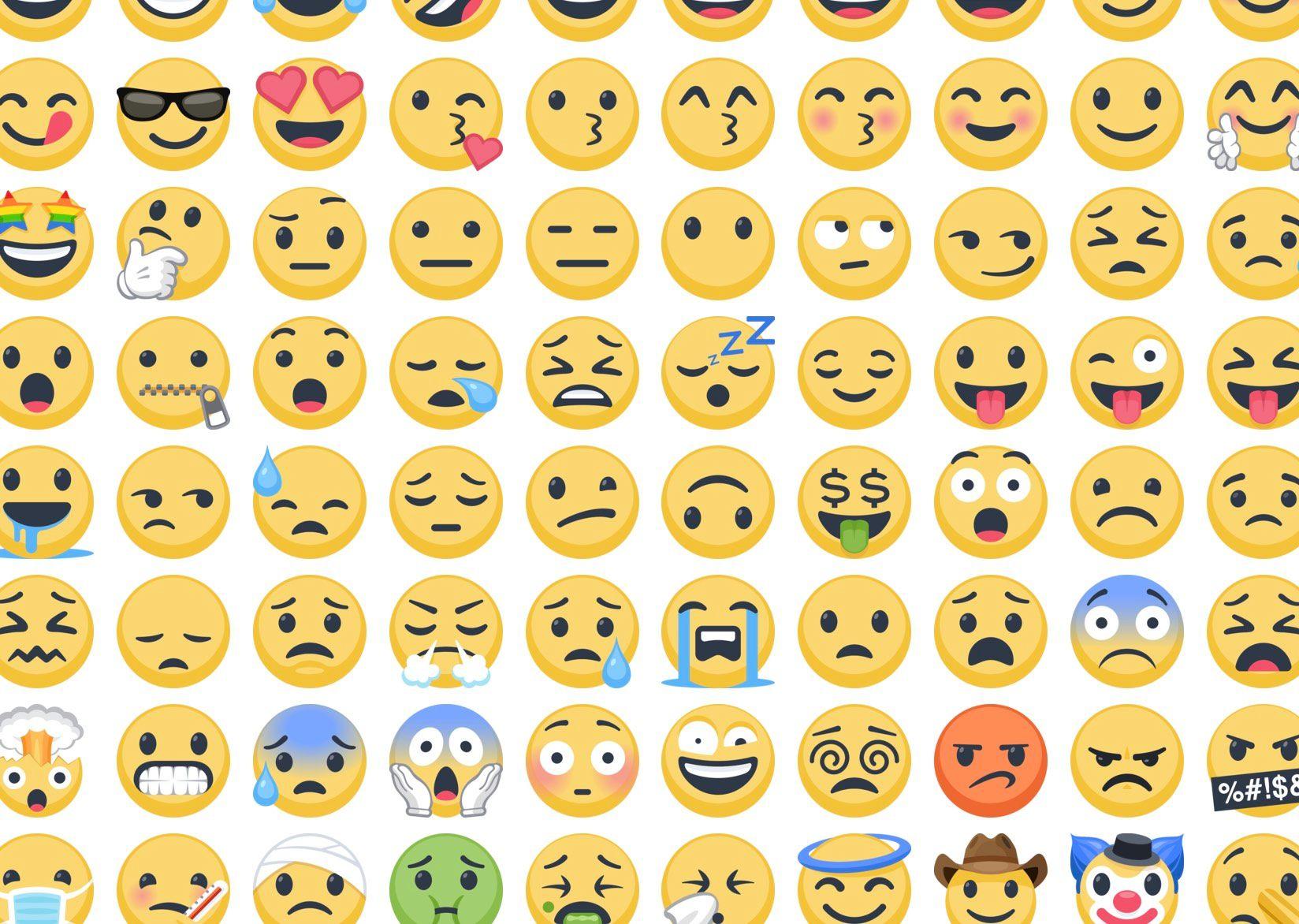
The tears of joy emoji was the oxford dictionary of the year. This book looks at the emoji and a modern day phonomena – and asks the question is the emoji a universal new language understood by everyone around the world that is ever evolving or is it a passing fad?

The emoji and its association and impact on art and literature

I am really looking at why do we need emoji in online communication? Is an  emoji basically a form of emotional punctuation and why is it so vital for interpersonal communication especially when used with friends and family?

I wanted to look at the book written by Olivia Laing, especially the essay titiled The future of loneliness, 2015. Even though it was written nearly 9 years a go, it becomes more pertinant every day. She looks at the author Jean Cocteau, the film I,BE Area,2007 by Ryan Trecartin, Lauren Cornell and the  2015 Triennial a group exhibiton that reflects on post-internet existence called Surround Audience, featuring artists such as Josh Kline, and Nadim Abbas.

https://frameweb.com/article/art/2015-triennial-surround-audience


Other books, plays and films that I could watch for research.

The human touch, Jean Cocteau

book to go with the exhibition Surround Audience

Art – Josh Kline, Freedom, Nadim Abbas, Edward Hopper

Film by Ryan Trecartin – I-Be Area


Exhibition and related book, Surround Audience – from 2015 Triennial, New York

Book  – Jennifer Egan, A visit from the goon squad

article – Trevor Paglen Frieze

https://www.frieze.com/tags/trevor-paglen

jon Ronson in So you’ve been publicly shamed

Sherry Turkle 2011, Alone together

The history of the emoji

This will be the start of my research into the emoji and the beginnings of other universal icons that often have an historical route in analogue symbols.

eg.

https://www.youtube.com/watch?app=desktop&v=ylVVhqH-cbA


https://www.artandobject.com/news/brief-history-emojis


iF Design - Emoji: A brief history ✨🎨📱🙌

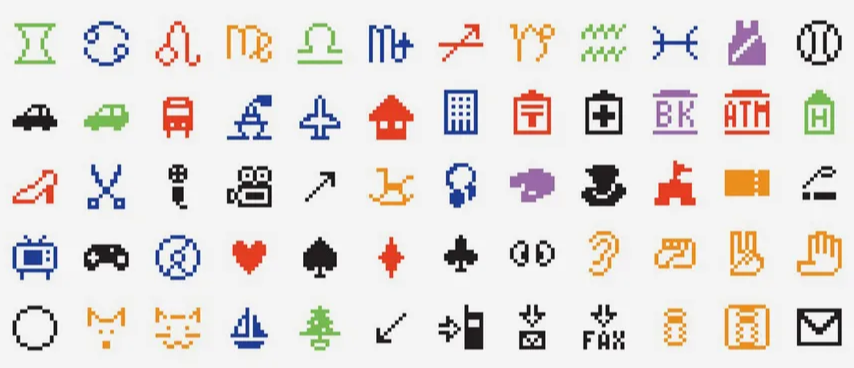
The image above is the original design from Shigetaka Kurita. In 1998 set about creating a large group of symbols for a messaging service. He was perfectly suited to the job, a gamer and a user of Pokeberu, a forerunner to emoji. He was able to predict the kinds of signs users may need to help facilitate a conversation. his icons consisted of 176 symbols but only included 5 face emoji – happy, sad, angry, disappointed and dizzy. These proved to be the most popular and remain the most commonly used today.

Shigetaka Kurita. Emoji. 1998-1999 | Moma, www.moma.org/collection/works/196070. Accessed 5 Apr. 2024.

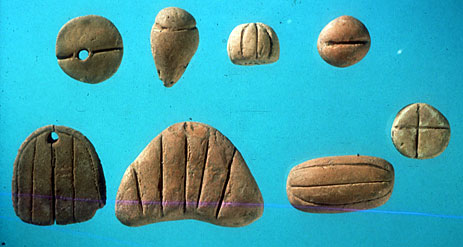
This was not really the beginning of emohji, both Pokeberu and and emoticons were earlier and  in many ways picture symbols or pictograms are the earliest forms of writing found, Much earlier than Egyptians Heiroglyphs and were being used as a form of communication by the people who lived at the time.


Went to the Cute exhibition at Somerset House

Recently I had been thinking about the direction of my critical essay, not sure to go with messy craft or to head more towards emotive symbols and how they evolve through human interactions.

I have been looking more at the everyday symbols and what they mean to me and the people around me as well as their universal inpact. For example emojicons as a form of emotional punctuation. Then, visiting the exhibition which was escientially about the cult of Cute and how it became so intrinsic to our use of digital media and how we communicate through it.

http://www.somersethouse.org.uk/whats-on/cute?

The emoji or the use of particular symbols to add and exagerate emotions are in evidence throughout the exhibiton.

Annoyingly it won’t allow me to add pictures today, I’m not sure why.


I  am hoping it will suddenly appear.

So the artists thats work particularly caught my attention were, Mark Lecky (DazzleDark,2023)

Julien Ceccaldi (Dorr to Cockaigne,2022)

Juliana Huxtable (Untitled, 2019)

Maggie Lee (Hearts mission,2022)

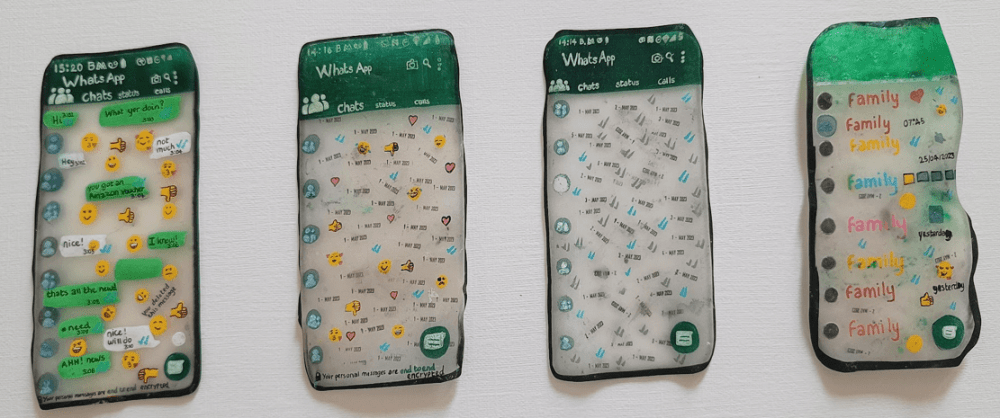
Whos video particularly caught my attention due to the fact it had many things in common with a 2D peice I made last year where I produced phone sized peices of work taken from inside a car, mainly at night. I had been looking for a way to finish them, the heart symbols that have been used as an afterglow from street and car lights bring attention to the ‘likes’ symbols of social media videos. What I also found interesting was how she  used personal experience of events and a time in her life and how I may need to illuminate this in my work too. I like the way she uses, Zines, photography and video as a blog or a diary to highlight her own experience as a teenager and young adult useing the tools to illuminate and “electroclash of unmixed colour  reminisient of indie sleaze.”


http://www.edouardmontassut.com/artists/maggie-lee

The other highlight from the show was

I bought it in the gift shop and although emojis and other digital symbols are used this book tells of the story of their inception and how they have evolved.

Its a facinating history that includes where the craze for using them came from and its links to communication study and their semantics. this segways nicely from the use of symbols in various artists work to comment and understand our use as a communication tool but also heiroglyphs, pictograms which were considered early forms of writing and letters.

https://sites.utexas.edu/dsb/tokens/tokens/

(Fig. 2) Tokens from Tello, ancient Girsu, present day Iraq, ca. 3300 BC. Starting above from left to right : 1 length of textile, one jar of oil, – ? –, one measure of wheat.  Continuing below from right to left: one ram, one length of rope, 1 ingot of metal, 1 garment. Courtesy Musee du Louvre, Department des Antiquites Orientales.


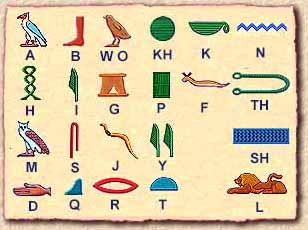
Egyptian Hieroglyphic Alphabethttps://discoveringegypt.com/egyptian-hieroglyphic-writing/egyptian-hieroglyphic-alphabet/

So as most of my work is a look at how we use universally excepted symbols and how we use them in familial acts of communication I think the history of emoji hits the nail on the head.

I need a question to get the ball rolling

Does the evolution of symbols or icons in digital media enhance personel communications?

Are we losing the ability to communicate on an emotional level with the increasing use of symbols and icons to denote are feelings?

Are emojis and other digital icons replacing in person -interactions?

‘Emoji are the body language of online speech’ discuss.

Does the use of modern symbols and icons such as emoji improve human communication?

This book will be pivotal in explaining the historical developments in communication and the theories behind  semiotics and lingusitics and how they are influenced by culture and media.

Introduction to Communication Studies (Studies in Culture and Communication)  : Fiske, John: Amazon.co.uk: Books

Baudrillard and ideas of simulcra

Thursday 14th March

I received a great message from Louisa Buck this week, she has set me the task of not only looking at academic theory and philosphy that looks at the effects of the digital on our society whilst also challenging me to find ways in which I can explain the evolution of communication. So the search is on!

I really like the idea of ‘sloppy craft’ as not just an anecdote to the digital and ideas of simulcra (see Baudrillard) but also as a means to explain the evolution of communication.

postcards -posts on social media (short public messages )

letters – emails (private correspondance)

The telephone handset for calls (and whatsapp) (although apparently the young don’t know how dial phones work!)

The speech bubble icon for text messaging

The semiotics of digital communication relies on traditional iconography used in analogue communication.

I think it might be good to start your essay with a relatively brief idea of what do we mean by communication… why we do it and why its SOOOO important.

Research suggests that whilst communication has never been more accessible loneliness and depression are on the rise. We still need the analogue world.

https://cla.purdue.edu/academic/english/theory/postmodernism/modules/baudrillardsimulation.html


look at links between William Morris and  Andy Warhol both were interested in commerce and its effects on society – The artist Jeremy Deller has used these connections to make an installation called ‘Love is enough’ 2015, at Oxford university, that connected the ideas and lives of these artists.

both were interested in how their works were made and the system of factory in production. This filtered through to their studios. Both were interested with commercilism and mass ownership. By putting together the work of these artists Jeremy Deller makes links between two big ideas, make connections industrial revolution to a digital culture.

The making of love is Enough: William Morris and Andy Warhol, curated by Jeremy Deller, 23.6.2016

Modern Art  Oxford/ Jeremy Deller: William Morris/ Andy Warhol Study day (feb2015)

Both were against the tastes of the rich, both were multimedia artists – and wrote many books.

utube


Modern art Oxford/


The contribution of ‘Sloppy Craft’ to the changing dynamics of craft in contemporary art

Sloppy Craft: It’s Getting Interesting….

I always think that communication means  sending a message from one place to another but messages come in many forms – not just corrospondance but also through the production of something for another to read. This mybe through creating art, maps, conversation, symbols, or ojects. So where to begin?… Maybe what I need to do is think How can I link semiotics and sloppy craft – That way I can look at how a message is constructed and how it is interpreted to enable an emotional connection (could this link to sloppy crafts reputation as a home spun amateur made object) Did William Morris have connections with forms of communication other than his art? What were his feelings on poorly made objects? His ideas sprang from wanted to bring art into every home (beauty not just for the rich) Although realistically if you were poor you were unlikely to buy William Morris Wallpaper.

Could the link be more about the materials and the form they take that sends the message?

The importance of being in person, the hands on experience, the physicality of the analogue that we are slowly losing through ease and convience that means there is a pay off. Thomas Hirshhorn mentioned energy yes quality no! but should it read energy yes, convenience no! Maybe he means more about the process of doing builds the message with energy replicating the speed and energy of digital messages but both can be sloppy creating new meaning

In conclusion, I don’t think I have decided what form of what communication means to me other than Whats app messages – is it what I feel I’ve lost, what I would rather have. I would rather have the comfortable physical presence and the ease of physical proximity to enable chit chat and in the moment interactions.  The real-time form of a digital message tries to replicate this comfortable ease of chat but it misses on emotional imput. We need to use emoji, clear statements and unitended ways to find emotional connections with those close to us. Personally, I use the survaliance aspects of Whatsapp to moniter and care for my children, online apps, daily quizzes like Wordle when we can share our results and comment which in itself becomes a form of communication. However what I really want is for them to be with me in that moment, playing games, chatting in the kitchen. Maybe the link occurs becauses we need physical connection.
Focus on one artist

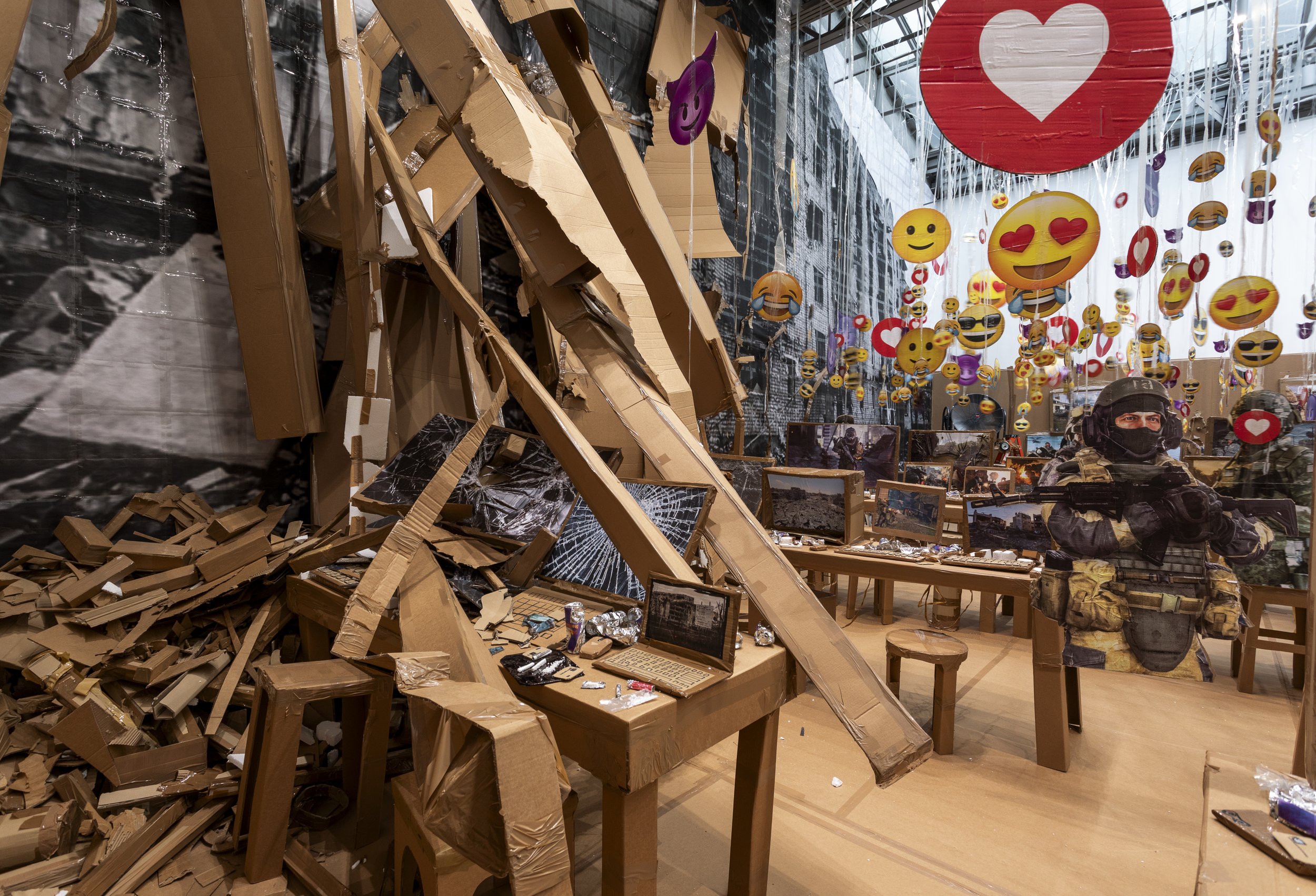
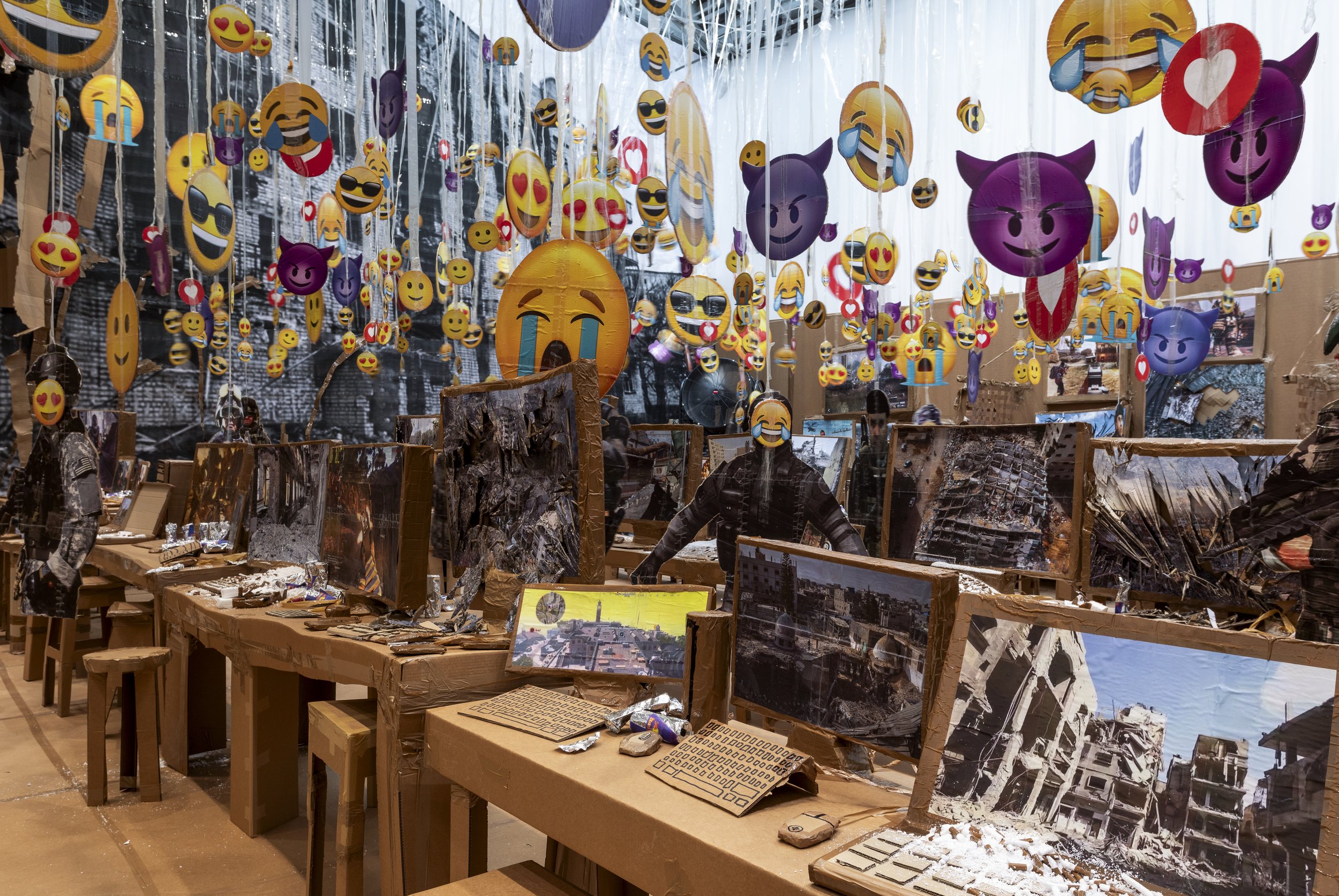
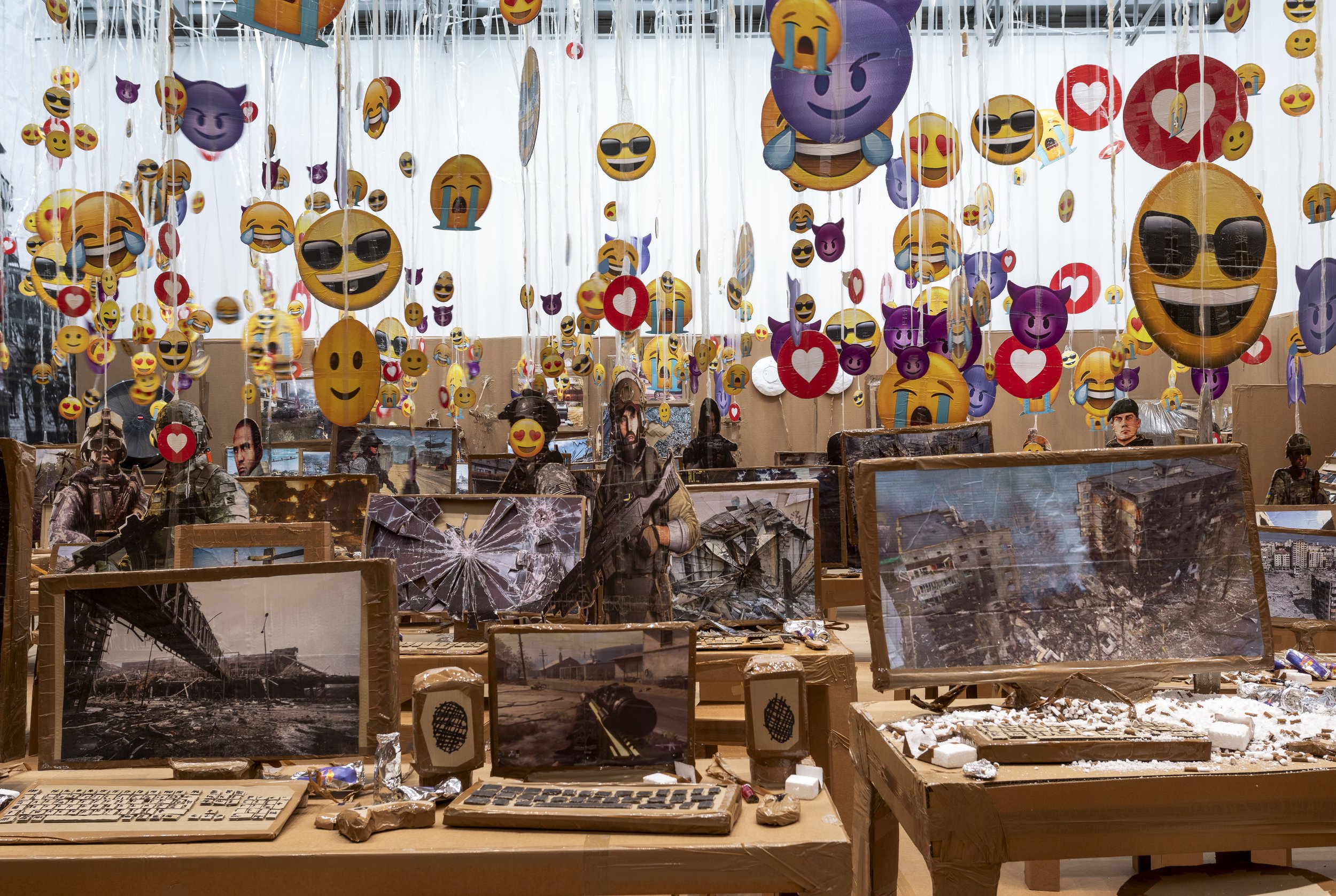
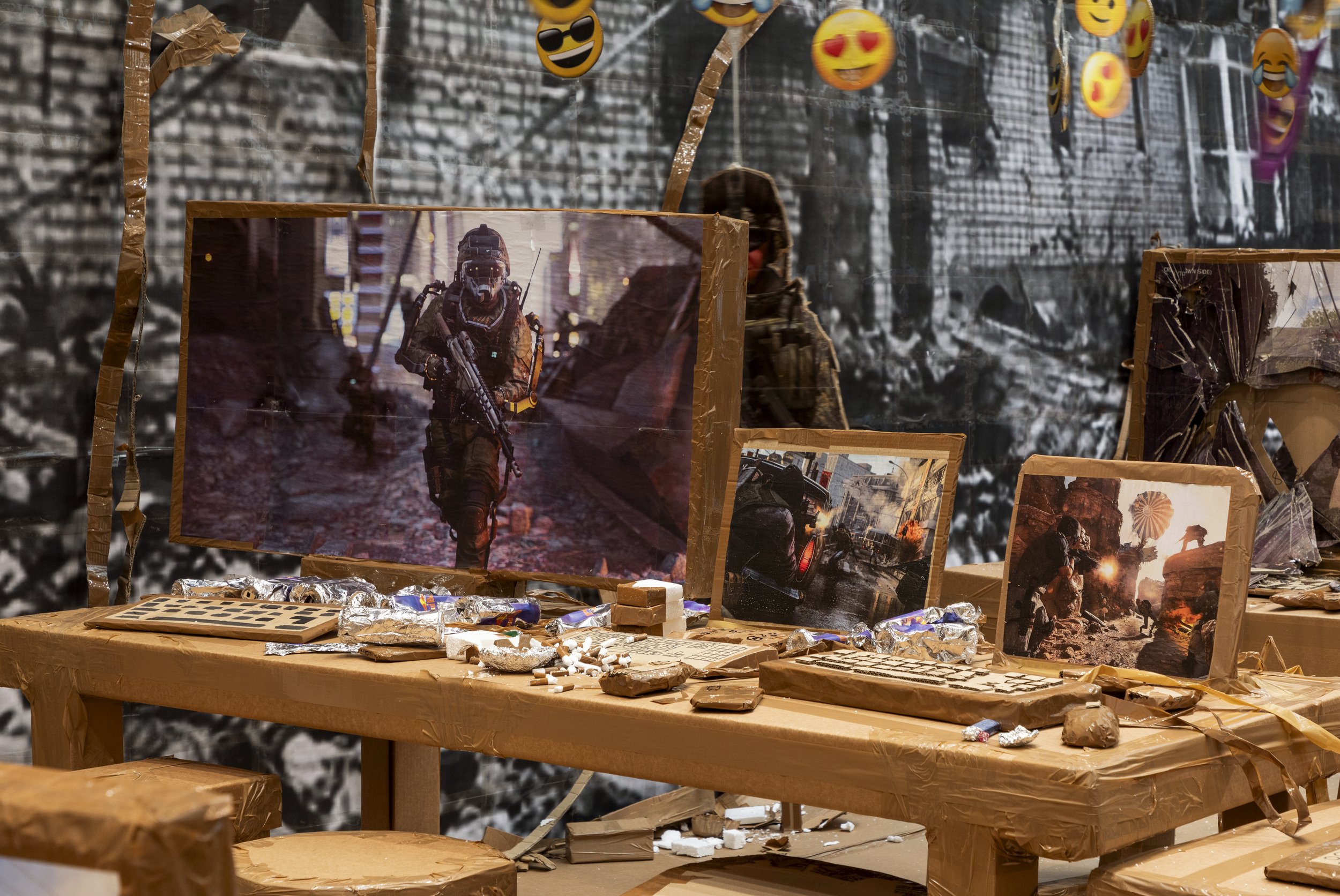
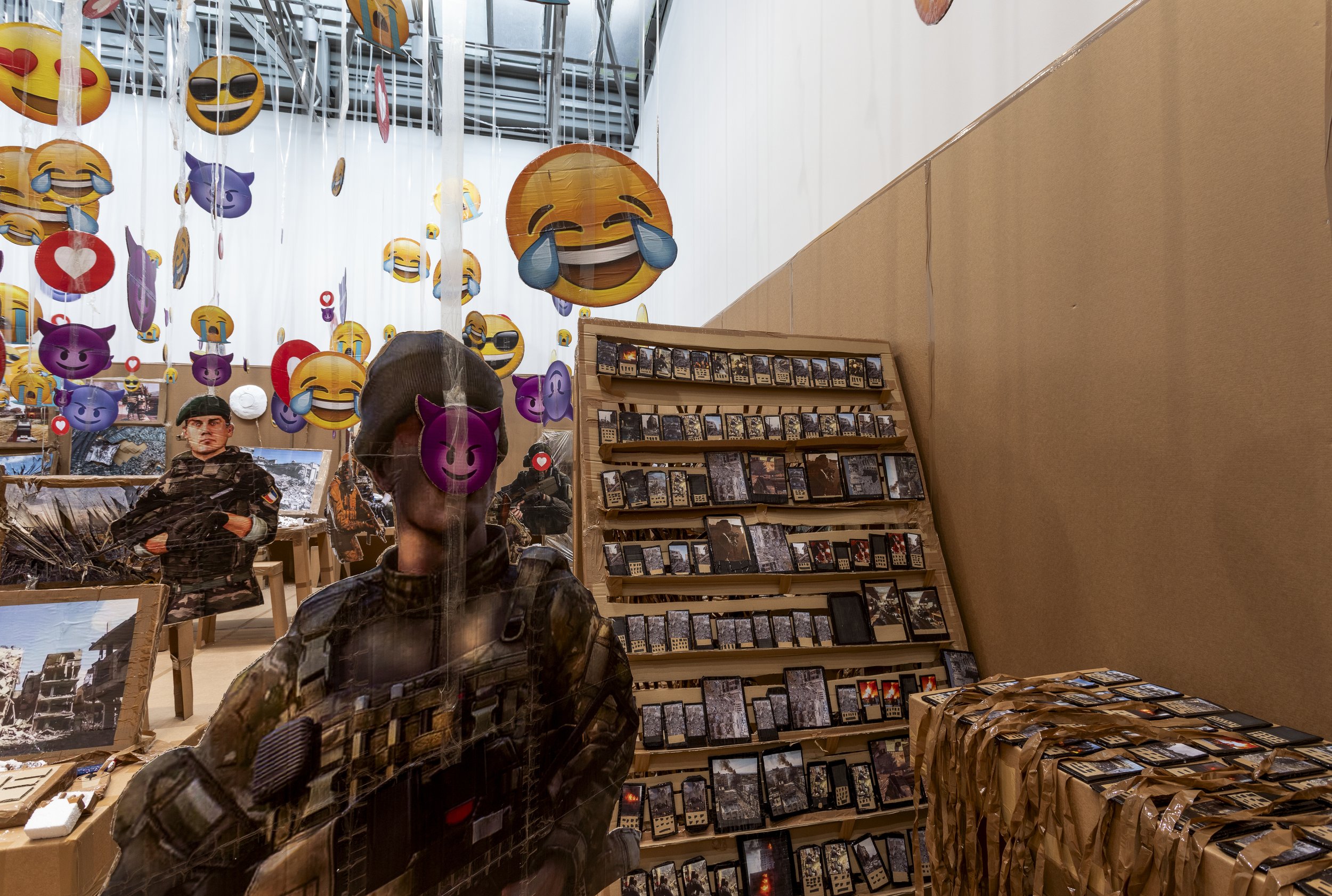
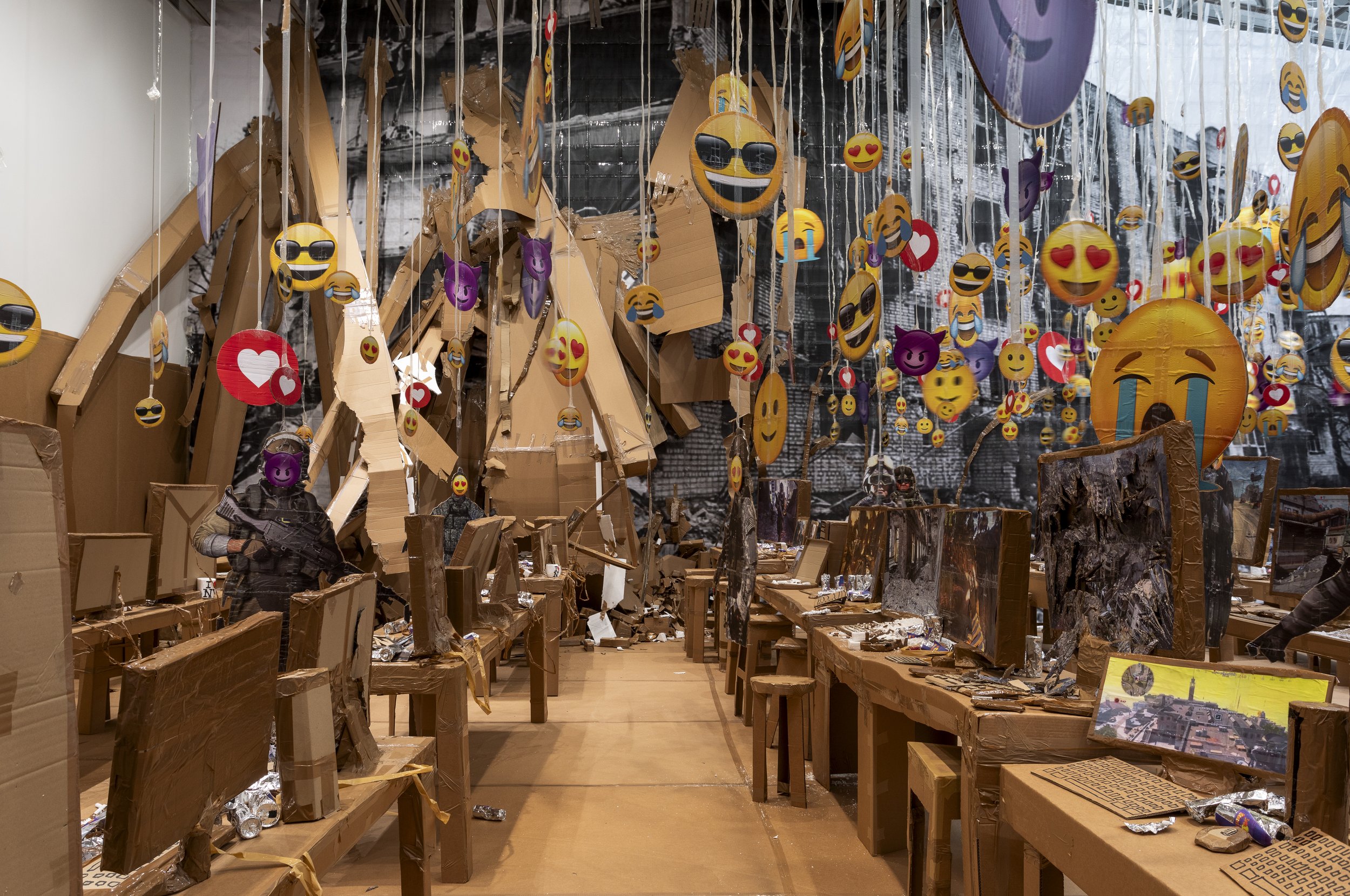
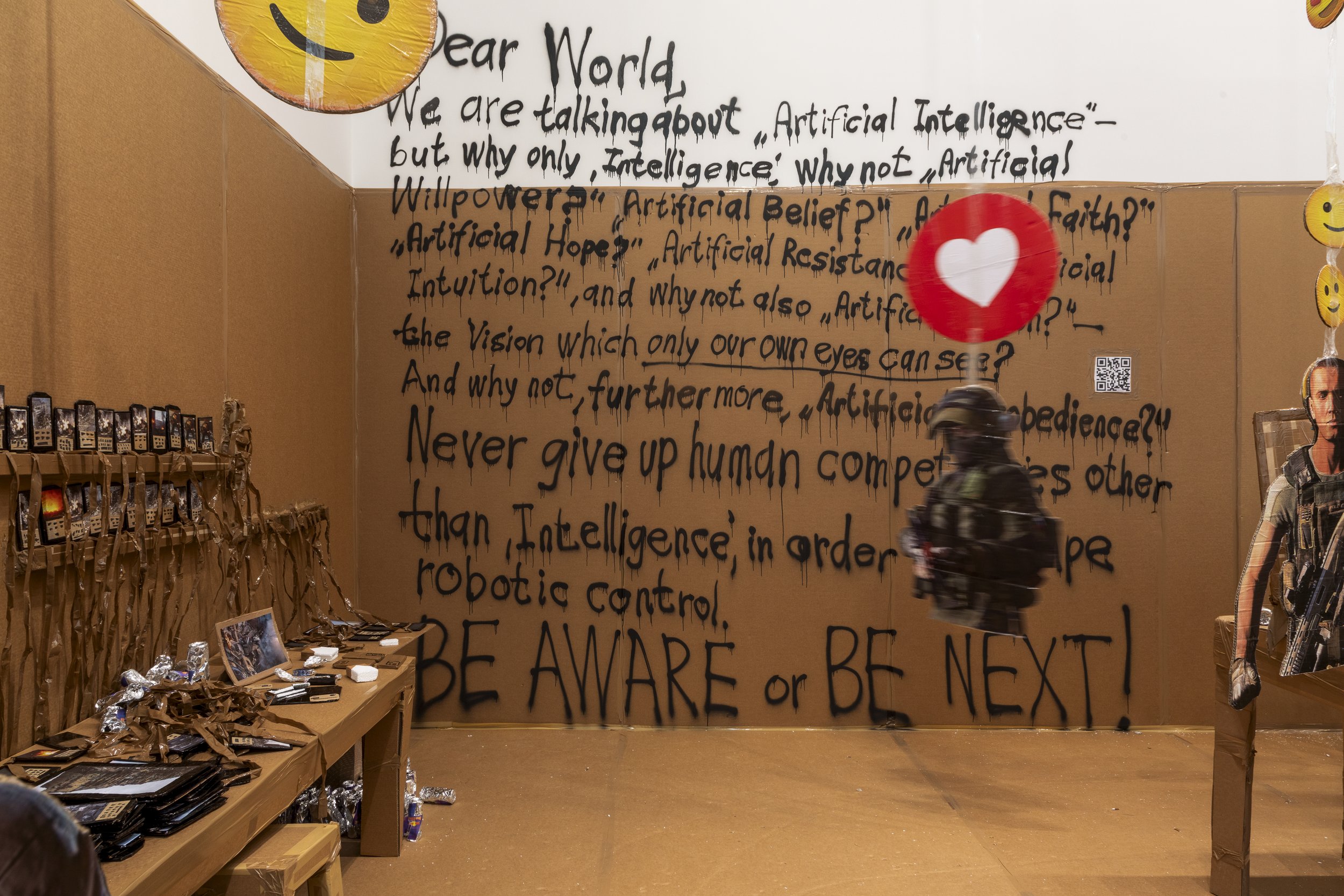
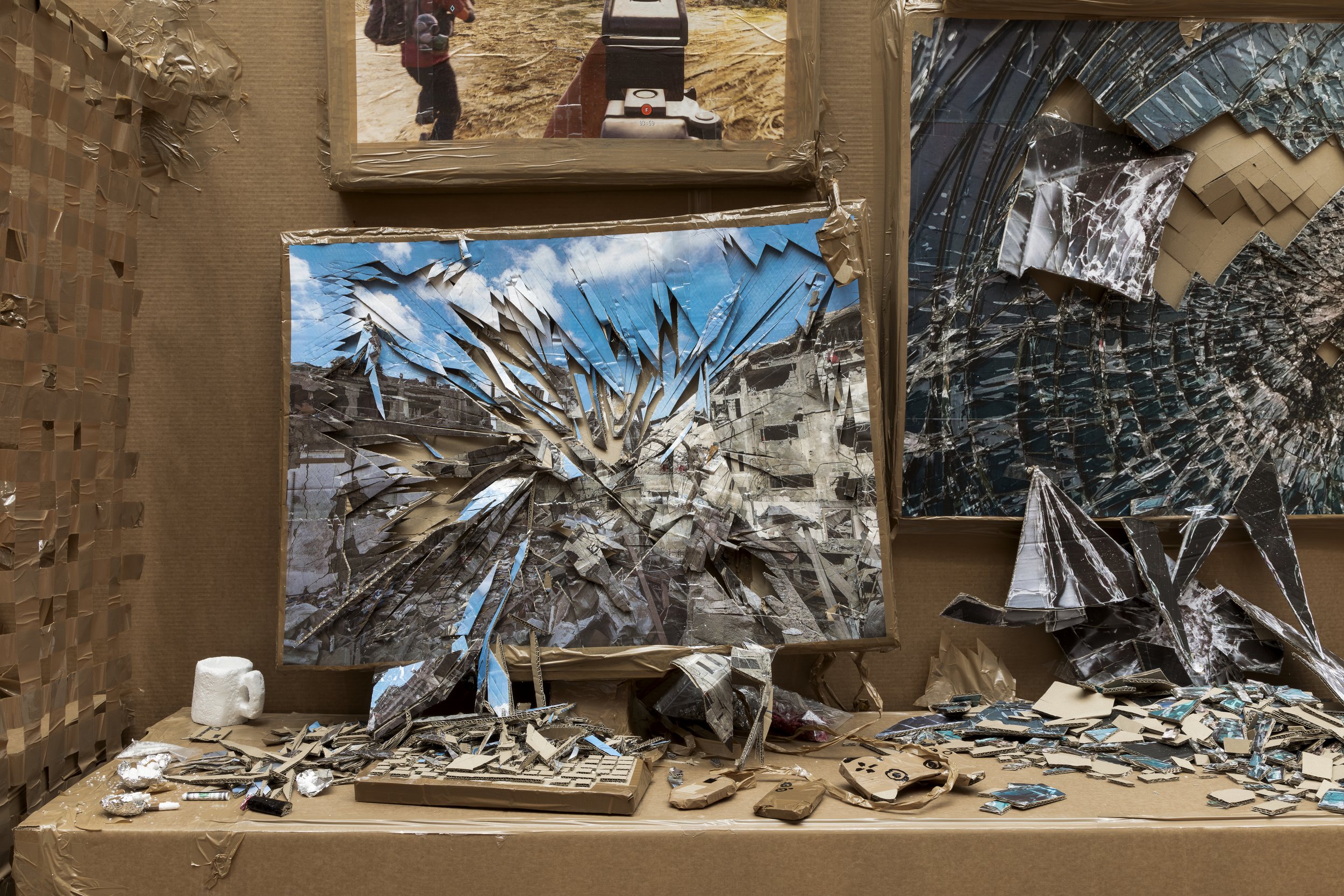
Thomas Hirshhorn at the Gladstone gallery New York, ‘Fake it, fake it – till you fake it’ based on a proverb by Silicon Valley. (2024)

undefined

undefinedundefined

undefinedundefined

undefinedundefined

“Fake it, Fake it – till you Fake it.” – Gladstone Gallery New York, 2024​” – Photos David Regen

The idea I have had is to  use this peice by the artist by Thomas Hirschhorn as the focal point of my critical essay. The content of this peice shares many similarities with my own work. The obvious aesthetic likeness is the use of hearts and emoji and the use of mobile phones. However, it is the form and his themes that are expressed through the materials and the making of his work that share my own values and intentions within my work.

Hirschhorn made this peice and others out of cardboard and packing tape. building his epic structures in a intentionally sloppy and amateur way. His reasoning is that the handmade and sloppy construction is counter to the perfection of digital online content.

This is the intention of my work that the importance of handmade crafts is the analogue to rival the digital. A kind of – what is lost physically through online communications, the pleasure of the physical process as apposed to the end result. My work has the aesthetic of the 80’s and 90’s, pre-digital and it is the nostalgia for my youth that informs this work. Similarily, when there has been other huge transistions in our society like the Arts and crafts movement that was set up as a way to reclaim and hold on to handmade crafted and specilist skills amid the new production of identically manufactured goods.

The 60’s saw a similar backlash to the new consumerist culture, through pop art many artists critiqued the use of advertising and the mass produced products of the time.

Ed Ruska, in his peice 100 gas stations purposefully shot all of them using as little technology as possible to make a statement on how society was changing and the effects of capatalism.

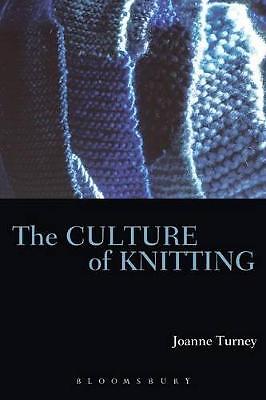
This ties into a book I found recently on messy craft and how it can be used as a way to celebrate the physical experience over the visual.

Sloppy Craft: Postdisciplinarity and the Crafts: Amazon.co.uk: Elaine Cheasley Paterson (Editor), Susan Surette (Editor): 9781472529008: BooksThe Culture of Knitting - 9781845205928 - Picture 1 of 1

Over the years, Hirschhorn has created more than seventy works in public space, questioning the autonomy, the authorship and resistance of a work of art, and asserting the power of art to touch and transform the other. “I want to use art as a tool to establish a contact with the Other – this is a necessity – and I am convinced that the only possible contact with the Other happens “One to One”, as equal.” Through his experience of working in public space, Hirschhorn has developed his own guidelines of “Presence and Production” in being present and producing on location during the full course of his projects. “To be ‘present’ and to ‘produce’ means to make a physical statement, here and now. I believe that only through presence—my presence —and only through production —my production— can my work have an impact in public space or at a public location.” From Thomas Hirshhorn’s Bio (artists website)

It would be interesting to see if I can find a link between the evolution of  communiction and the sloppy craft as a antidote.

Great and relevent quotes:

Confrontation between the analogue and digiatal and back is the strategy with which he is focused.

My work is a comment on the world I live and my experiences within it.


Tuesday 5th March

I have a group meeting for my Critical review today so I have been cramming in the reading and research.

The two books I’ve been looking at are :Introduction to Communication Studies by John Fiske

There is a whole section that discusses communication, meaning and signs. The article states that the models have only considered the ‘process’ of a message and this study looks at communication as a generation of meaning. An exchange of codes that becomes more personalised the more we send and repeat them. You are creating your own meanings with the signs, the more these sign systems and codes are used to the same group the closer those meanings will align.

There are a set of terms that discribe this form of communication: sign, signification, icons index, denote, connote all terms which refer to various ways of creating meaning.

The word that particularly stuck out to me was ‘Semiotics’ the study of the sign. The main areas of study being: the sign itself; the codes or systems into which they are organised and the culture within which these codes and signs operate. (Fiske, 1987) This is potentially interesting as its the symbols, or icons within social media and messaging apps that are loaded with meaning and are used to send and receive messages. I am interested in the emotional response they create and how these icons trigger are dependency on these platforms to communicate.


Potential questions

Can semiotics explain how symbols and signs are used in digital media to illicit an emotional response?

(not sure this entirely makes sense but it could be a start)

Can craft made objects be a tool to investigate the postive and negative of digital messages?

Has digital media changed how we communicate emotionally?

Has communicating via digital messaging platforms led to a loss of physical and emotional engagement?


As an aside and not connected necesserily connected to my research I came across a post on Substack by the Honest Broker, that talks about how entertainment ate art. Distraction ate entertainment, addiction is eating distraction and media companies are a domopine cartel and this is where all the investment goes.

fifteen second bursts to stay on their platform. – instagram, X . They want you angry because you are more likely to stay longer and use your data. They know how toxic it is but it makes a lot of money, and is causing depression. Distraction from the real pleasures in life.

The expression ‘This is not second screen enough’ with the idea that most people will be scrolling while watching the tv. Is this addiction? Is it ruining our concentration?

Potential questions

Can semiotics explain how symbols and signs are used in digital media to illicit an emotional response?

(not sure this entirely makes sense but it could be a start)

Can craft made objects be a tool to investigate the postive and negative of digital messages?

Has digital media changed how we communicate emotionally?

Has communicating via digital messaging platforms led to a loss of physical and emotional engagement?

There are a few artists that are also concerned with these themes in their work:

Amalia Pica

Rachel Mcread

Thomas Hirschhorn

The project twins


Monday 4th March 2024

So today I have decided to set up a blog  – I lost the first page so hopefully this time it will work better.

I am starting this blog as a way of recording what I read and a place to add my stream of consionses writing on articles and books I read. I haven’t yet found a way to either change the font or to spell check which is disappointing but a way round this could be to put it on a word document first. Although why bother with the blog posts just print the word pages onto a dairy pre- printed sheet as a background.

So I need a question! which will encompass:

communication, feminism, motherhood, symbols, emotional connections and communication, nostalgia for a pre-digital age Whatsapp, or social media and cross platform messaging, my favourite artists that may give an example of how icons are used in art. How do the universal symbols work on us emotionally?

Books read

How does fiction fuel contemporary art? written by Marie Sahy

Women in revolt

Motherhoods, Markets and Consumption


Sites visited

https://www.alphr.com/whatsapp-emoji-meanings/

Social Media and Governance: The Disequilibrium of Communication and Commodification