Summary
Looking at the work of Xu Bing, finding parallels in my work and his.
So now I have decided that emoji are the way forward for my critical essay – I need to start picking apart the different elements in the text ‘The semiotics of emoji’. Looking at who the book references and use them to further my own research.
One of the aims is to connect art making to emoji whereever possible for my own work and for the essay.
The chapter emoji grammar mentions an artist Bing Xu – he constructed a written peice entirely made from emoji. On this page I will take a closer look at his work to find parallels within my own work and to see what connections there maybe to how I answer my critical essay question.
This is the artist’s website.https://www.xubing.com/en/work/details/188?classID=10&type=class

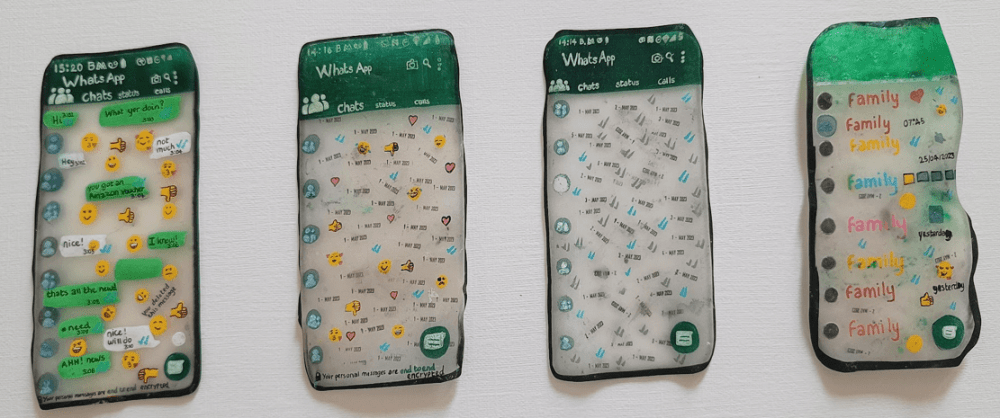
Although this peice is not about emoji, I have put it in as it shares themes in some of the work I had been making. exploring ideas of messages that are taken for granted but have a function. Communicating a caring act – which ties in with how we care for family through the written and symbolic forms found on digital apps, double ticks, heart emoji, checking in messages ect.

title – ‘The genetics of reading image’
‘Shows that visual and phonic writing are merging more and more.’ Marcel Danesi, the semiotics of Emoji

links to work I made about Wordle last year. – This could be a useful idea for presenting my critical essay.
emoji writing from ‘point to point’ by Xu Bing
 https://artreview.com/ara-springsummer-2014-book-review-xu-bing-book-from-the-ground/
illustrative signs and emoticons, all taken from real symbols in use around the world. The artist has collated these over a period of seven years and used them to devise a universal ideographic language, in theory understandable by anyone engaged with modern life.
On one level Xu achieves his goal: it doesn’t take too much effort for the reader – ‘interpreter’ might be more appropriate – to decipher the central character’s day. Mr Black decides what shoes to wear (Lacoste, Adidas, Nike logos) and what to have for lunch (McDonald’s arches, illustration of a steaming steak/bowl of noodles/ sushi). He becomes increasingly stressed (series of anxious-face emoticons, each shedding an increasing number of drops of sweat) preparing for a work presentation. There’s humour, too, some of it slightly odd and scatological, as when Mr Black is straining on the toilet (coiled turd with a red line through it, more sweat-shedding emoticon faces). But perhaps this merely reflects the universality of toilet-related symbols. The accompanying explanatory book, The Book About Xu Bing’s Book from the Ground, includes documentation of the wider project when it has been presented in the context of an exhibition, and includes its development as a software program that translates Chinese and English text into pictograms and symbols. Essays and an interview with the artist put the novel in context, both in terms of Xu’s previous work and in terms of historical and more recently devised pictographic languages – not forgetting that the Chinese also retains pictographic roots. –
This section from Art Review explains this peice – it would be interesting to see if I can find the software that changes written english into emoji.
These pages are also interesting in relation to a form of literacy known as ‘Talk for writing’ that was divised to help children to write imaginatively and to understand how a narrative is formed within a text. I have used this method when teaching English in primary schools and through child generated symbols the children match a word, action and the symbols they suggest are put together to learn the key text.
https://www.talk4writing.com/resources/planning/
https://www.youtube.com/embed/en73Pi1V_1c
Pie Corbett who invented talk for writing in schools to help with literacy.
